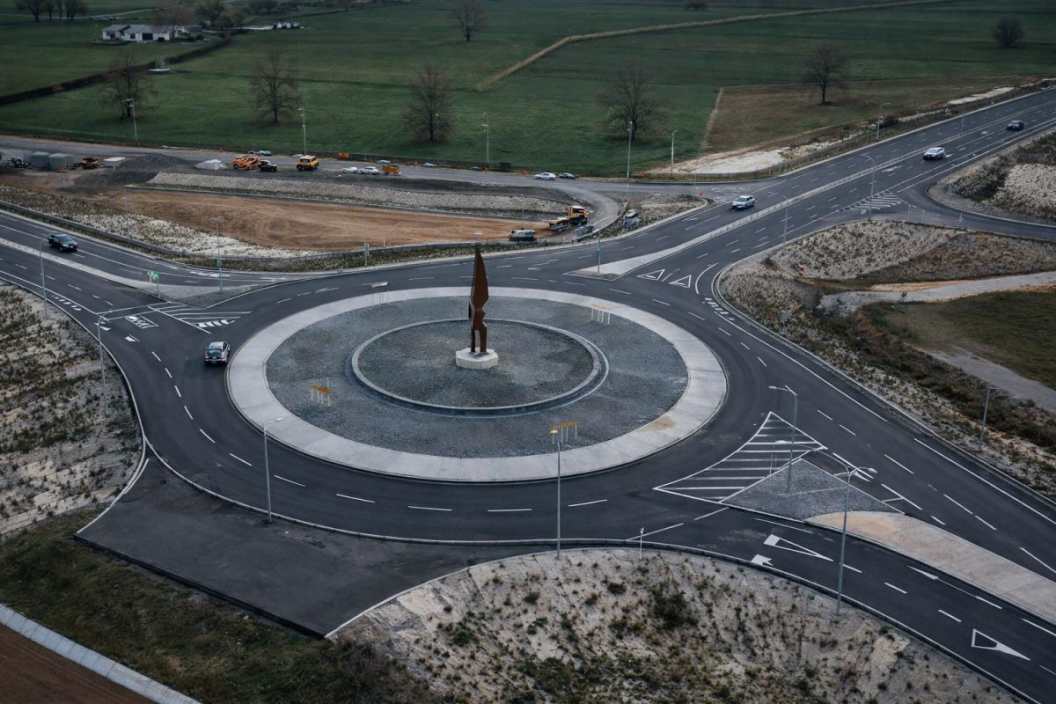
Roundabouts or Traffic Lights: How New Zealand Chooses an Intersection
Ask a New Zealand traffic engineer to choose between a roundabout and a set of signals and the answer will not begin with congestion. It will begin with what happens when somebody gets it wrong at 80km/h. The choice is made on crash geometry first and queue length second, which is close to the reverse of how the argument usually runs in a council chamber.
The Choice Is Made on Crash Geometry, Not Congestion
What an Intersection Has to Resolve
Every intersection is an argument about the same few square metres of tarmac. Two or more traffic streams want to occupy them, and something has to decide the order.
Give-way signs push that decision onto drivers. Signals take it off them entirely and hand it to a controller box on the footpath. A roundabout does something different again – it leaves the decision with drivers but deletes most of the choices they can get wrong.
New Zealand has run all three at scale, and the 2012 give-way rule change was a useful reminder that a large share of intersection risk sits in the decision rule rather than the concrete. Control type is not a detail bolted on at the end of a design. It is the design.
Counting Conflict Points
Engineers do not start with delay. They start by counting the places where two vehicle paths can touch, and a standard four-arm intersection is grim arithmetic. Under give-way control or signals it carries 32 vehicle conflict points: 8 diverging, 8 merging, and 16 where one path crosses another at close to a right angle.
Convert the same four arms to a single-lane roundabout and the standard conflict point counts drop to 8 – four merges on entry, four diverges on exit, and no crossing conflicts at all.
That is the structural argument in a line. A roundabout does not make drivers better; it removes the manoeuvre they are worst at, which is judging a gap while turning across traffic at speed.
The Safe System Premise
Counting conflicts only matters if you accept the premise underneath it. The Safe System approach that shapes New Zealand’s road safety work starts from an unflattering assumption: drivers will make mistakes, and the road should be built so those mistakes are survivable.
Human tolerance becomes the design input. Someone in a modern car has a reasonable chance of walking away from a side impact at around 50km/h, and very little chance above it. For a person on foot the cliff edge sits nearer 30km/h.
Once those numbers are the constraint, the question changes shape. You are not picking the option that moves the most cars, you are picking the one that holds the worst realistic crash below what a body can absorb.
Speed and Angle Do the Actual Work
The Right-Angle Strike Is the One That Kills
Severity is not really about speed. It is speed and angle together, and the right-angle strike is the combination that fills intensive care beds. A car is built to protect people in a frontal impact, with roughly a metre of structure crumpling before the cabin is touched. Hit the same car in the door and there is perhaps 30 centimetres between the impact and a person’s ribs.
The rural crossroads is the local version. Two open-road approaches, one driver misjudges a gap or never sees the other, and the closing speed arrives at a door.
Signals do not change that geometry. They change whose turn it is, and a driver who runs the red arrives at exactly the same angle.
Deflection Is the Whole Design
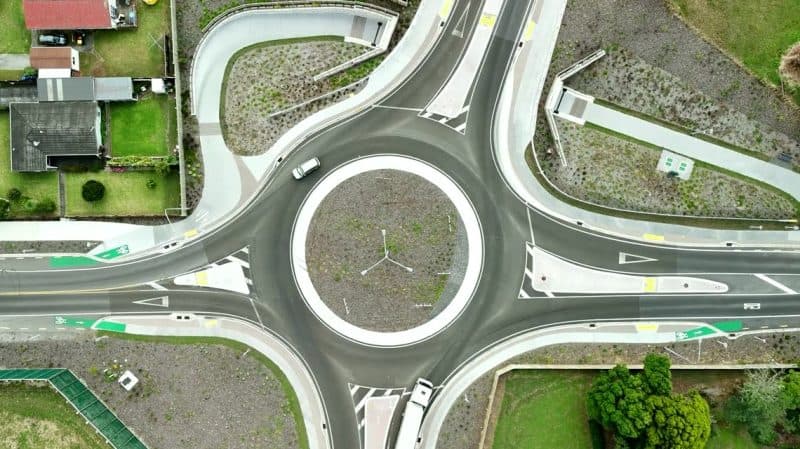
A roundabout works by making the fast path physically unavailable. Entry deflection – the curvature built into each approach so no vehicle can take a straight line through the circle – is not landscaping around a central island. It is the safety mechanism, and a roundabout with weak deflection is a roundabout that does not work.
Design guidance aims to hold entry and circulating speeds down in the 30s. What is left are shallow-angle manoeuvres, vehicles merging at 20 or 30 degrees rather than 90, which turns a potential strike into a sideswipe.
Get deflection right and the geometry does the enforcing; nobody has to be persuaded. It is also why widening a rural roundabout for truck tracking is delicate work, since every extra metre of radius hands some speed back.
Signals Keep the Ninety Degrees Intact
Signals separate conflicting movements in time rather than geometry. That is a genuinely powerful capability and a fragile one, because the crossing conflicts have not gone anywhere. They are held apart by a red light and the expectation that everyone honours it.
Mostly they do. The failures cluster in two places: the outright red-light runner, and the dilemma zone, the stretch of approach where the amber appears and the driver can neither stop comfortably nor clear the line.
Higher approach speeds stretch that zone and worsen what waits at the end of it. That is why signalising an open-road intersection is treated with caution here, and why a protected right-turn phase rather than a filter is the standard answer wherever turning volumes are real.
Delay, Capacity, and the Claim That Gets Overstated
Where Roundabouts Win on Delay
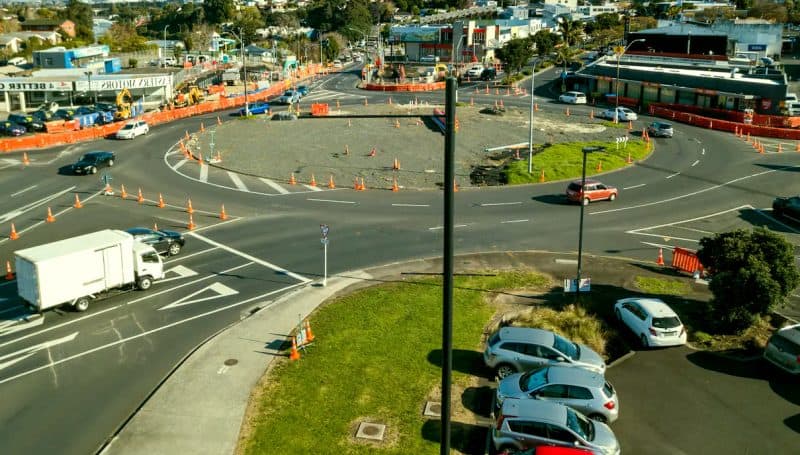
The capacity argument gets made as though it were the main event, and it usually favours the roundabout too – just not for the reason people assume. A roundabout has no cycle time. Nothing grinds through a fixed phase sequence at three in the morning making a lone driver wait 40 seconds for a green that serves nobody.
Across a full day under light to moderate flows, that produces lower average delay than signals at the same site, with less idling and a smoother speed profile.
It also degrades gracefully. A roundabout in a power cut is still a roundabout. A signal in a power cut is an uncontrolled crossroads that half the approaching drivers have not realised is uncontrolled.
Where the Circle Gives Up
Push the flows up and the arithmetic reverses. A roundabout allocates capacity to whoever turns up, which is fine when the arms are balanced and unworkable when they are not. A dominant arterial arriving in an unbroken stream leaves no gaps, and the side road stops discharging. There is no mechanism to make the arterial yield, because yielding is voluntary.
Signals can do precisely that. Green time is allocated by policy rather than by luck, and that is the one capability a circle cannot replicate. It is also what lets a corridor run coordinated progression, where successive signals are timed to carry a platoon through on a green wave.
A roundabout scatters platoons by design. Multi-lane versions buy headroom, but pay for it by reintroducing lane-change conflict inside the circle.
The People Who Are Not in a Car
Crossing on Foot
All of that assumes the person at the intersection is in a vehicle. Change the assumption and the roundabout’s advantage narrows fast, because continuous movement with no compulsory stop is exactly what makes crossing hard.
A pedestrian at a signalised intersection gets a phase. Traffic is stopped, the crossing is defined, and audible and tactile signals tell someone who cannot see the green man that it is their turn.
A pedestrian at a roundabout gets a gap, which they have to find themselves, in traffic that never stops and often occupies two circulating lanes. Blind and low-vision advocates have made this point for years and they are right. The fix exists – signalised crossings set back on each arm – but it hands back some of the delay saving the roundabout was chosen for.
The Cyclist Problem
Cyclists get the same problem with a worse failure mode. On a single-lane roundabout with real deflection and circulating speeds in the 20s, a confident rider taking the lane is reasonably safe. On a multi-lane roundabout they are in one of the least forgiving positions on the network.
Two mechanisms do most of the damage. An entering driver scans for a car-sized gap and does not register a bicycle in it. An exiting driver, already looking down the departure leg, turns across a rider who is continuing around.
Painting a cycle lane around the outside of the circulating carriageway makes both worse, because it places riders exactly where exiting vehicles cross. The arrangements that work take riders off the circle altogether, onto a separated path with its own crossing on each arm.
Cost, and the Places a Roundabout Is the Wrong Answer
What Each One Costs to Own
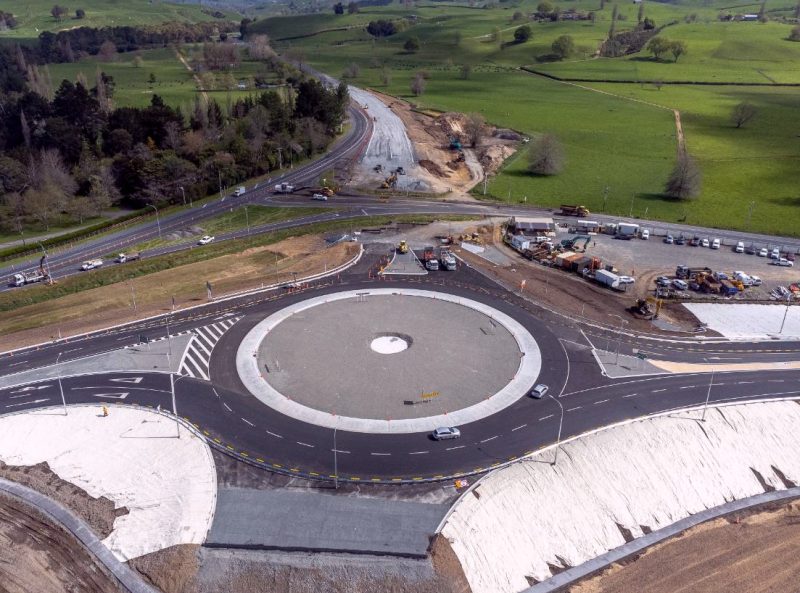
Capital cost is the number that gets quoted and the least useful one. A roundabout usually costs more to build, mostly because it needs land: a four-arm urban roundabout with adequate deflection and truck tracking occupies a footprint that signals do not.
After that, the ledgers diverge. A roundabout has almost nothing to maintain – kerbs, markings, planting, lighting. A signal installation carries a controller cabinet, detector loops in the pavement, lamps, communications, a phasing plan that needs periodic review as flows shift, and a full renewal roughly every 15 to 20 years.
Run both over 30 years and the roundabout is frequently the cheaper asset to own. Land availability is the variable that flips the answer, which is why the two options rarely compete on equal terms in a built-up centre.
Six Places a Roundabout Is Wrong
Being the default answer at a rural crossroads does not make it the answer everywhere, and the sites where it is plainly wrong are easy enough to name.
– Constrained urban blocks, where the footprint means buying and demolishing buildings.
– Badly unbalanced flows, where a minor approach would be starved by an arterial that never has to yield.
– Corridors that depend on signal coordination, since a roundabout breaks the platoons a green wave relies on.
– Central city intersections with heavy pedestrian volumes, where pedestrian delay swamps the vehicle saving.
– Routes needing bus priority or emergency vehicle pre-emption, which a controller can grant and a circle cannot.
– Sites where grade or sight lines make real deflection unachievable.
That last one deserves weight. A poorly deflected roundabout is not a compromise. It is a hazard with a garden in the middle.
How the Decision Actually Gets Funded
None of this reaches the ground without money, and that money runs through a specific pipeline. The National Land Transport Programme, or NLTP, is the three-year schedule of what gets funded from the National Land Transport Fund, set by the NZ Transport Agency within the priorities government lays out in its Government Policy Statement on land transport, the GPS.
For a council project, only part of the cost comes from that fund. The Funding Assistance Rate, or FAR, is the share the fund contributes; most councils sit at or near 51 percent, with higher rates where the rating base is weaker. Ratepayers cover the balance.
Because business case assessment weights deaths and serious injuries avoided heavily, the safety arithmetic is also the funding arithmetic. A rural crossroads with a crash history is a fundable roundabout. The same intersection with a clean record usually is not.
The roundabout usually wins on the measure that matters most and loses on the ones that are easiest to argue about in public. It buys down the severity of the crash nobody managed to prevent, quietly, for thirty years, with no maintenance contract to speak of. What it cannot do is give a green phase to a bus, a blind pedestrian, or a side road nobody would otherwise let out of – and those are not edge cases, they are the reason signals still get built.
3 Comments
The bit about deflection is the part that never makes it into the public consultation material. We inherited a roundabout on a rural approach where the entry radius is so generous you can hold 60 through it without touching the brake, and the crash record shows it. It’s not a roundabout, it’s a bend with priority rules.
Good to see the pedestrian side given proper weight rather than a footnote. Your point about gap-hunting across two circulating lanes is exactly the objection our access group has been making for years and getting nowhere with. Do you know of any NZ examples where the set-back signalised crossings actually got built as part of the original scheme rather than retrofitted after complaints?
Fiona, I’ve seen it done on a couple of newer schemes but usually only where the pedestrian count was high enough to force the issue at business case stage. Which sort of proves the article’s last point – the funding arithmetic decides, not the design intent.