Median Barriers and Wire Rope: How NZ Stops Head-On Crashes
On an open road the only thing keeping two streams of traffic apart is a painted line and a hopeful assumption. Median barriers are what happens when a road authority stops trusting the paint. Here is how wire rope barriers actually work, why New Zealand installs them, the genuine debate they provoke — including the motorcyclist concern — and what the crash numbers say about whether they earn their place.
The Head-On Problem Median Barriers Solve
Why the Centreline Is the Deadliest Line on the Road
On an undivided road, the only thing separating two streams of traffic closing on each other at a combined speed of 200km/h is a painted line and the assumption that everyone stays on their own side. That assumption fails thousands of times a year — a moment of fatigue, a glance at a phone, a patch of black ice, an overtake that runs out of room. When it fails, the result is a head-on or a run-off-road crash, and these two crash types account for the large majority of deaths and serious injuries on the open road. The painted line carries enormous responsibility and offers no physical protection at all.
The uncomfortable truth that sits behind every median barrier is that the centreline was never a safety device. It is a guidance marking. For most of the history of the network we treated a 100mm strip of paint as if it were a wall, and we built road after road on that fiction. Median barriers are what happens when a road controlling authority stops pretending the line is enough.
The Safe System Shift: Designing for Human Error
The thinking that drives barrier installation is the Safe System approach, the foundation of New Zealand’s Road to Zero strategy. Its core premise is blunt: people will keep making mistakes, and a road system worth having is one where a mistake does not have to be fatal. You cannot engineer human error out of existence, so you engineer the consequences down instead.
A flexible median barrier is the purest expression of that idea. It does not stop the driver drifting across the centreline — it accepts that they will, and it makes sure the drift ends in a damaged car and a frightening jolt rather than a closed-casket funeral. This is a genuine shift in responsibility. The old model put the entire safety burden on the driver behaving perfectly. The Safe System spreads that burden onto the people who design, build and maintain the road, which is a far more honest place for it to sit.
How Wire Rope Barriers Actually Work
Catch, Deflect, Absorb: the Physics of a Flexible Barrier
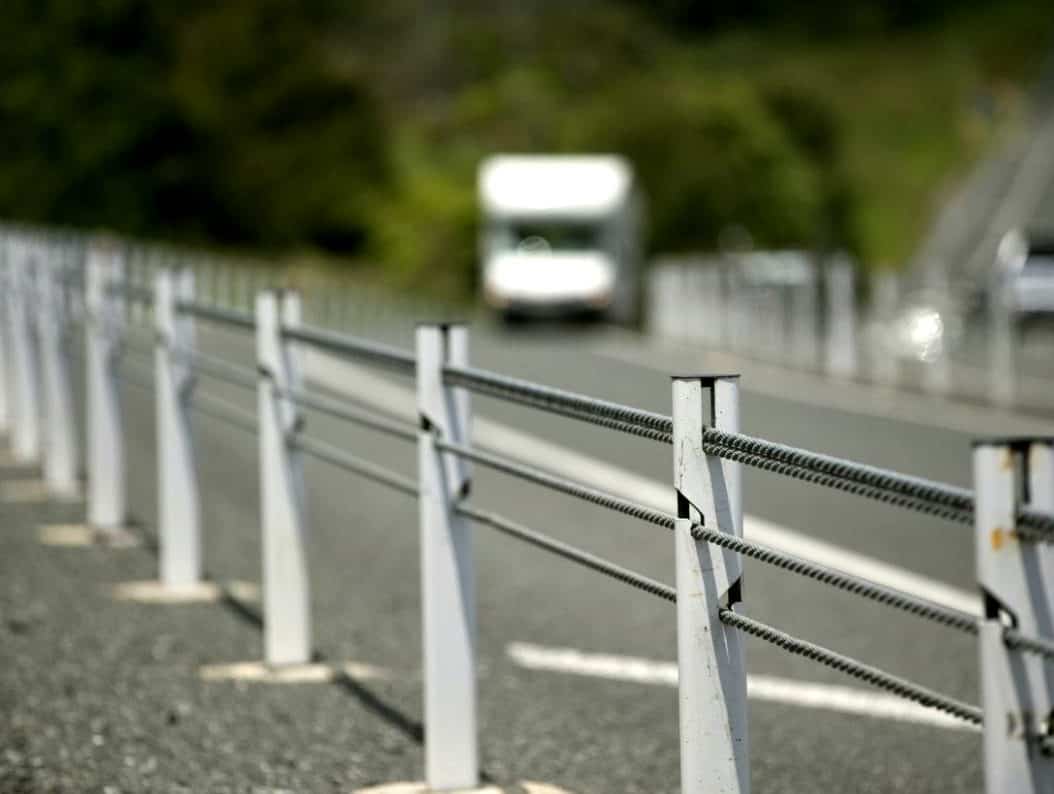
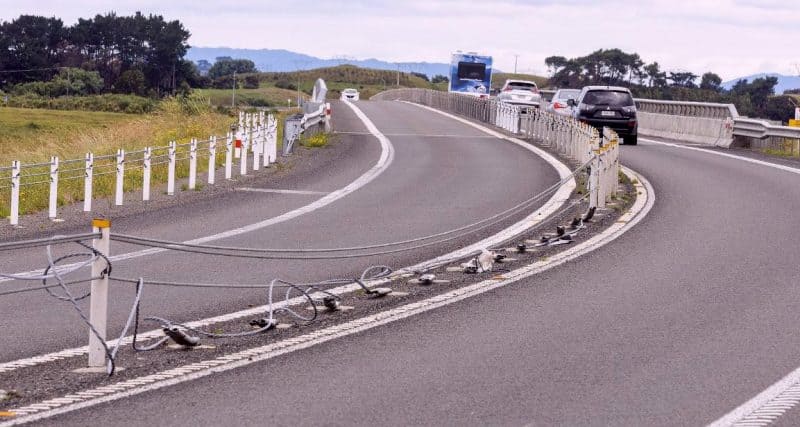
A wire rope barrier — known internationally as a cable barrier — looks almost flimsy: three or four steel cables strung at varying heights between slim posts set in the median. That appearance is deliberate and misleading. When a vehicle hits it, the cables flex and the posts shear away, and the barrier behaves less like a wall and more like a catcher’s mitt. It deflects sideways, sometimes a couple of metres, and in doing so it stretches the crash out over time and distance.
That stretching is the whole point. The injuries in a crash come from sudden deceleration — the faster a vehicle is brought to a stop, the more violent the forces on the people inside. By giving way and absorbing energy progressively, a flexible barrier lowers the peak forces dramatically compared with hitting something rigid. The car is redirected back roughly parallel to the road rather than bounced into traffic, and the occupants walk away from a crash that on a bare median would have been a head-on.
Wire Rope, Concrete and Steel: Three Tools, Three Jobs
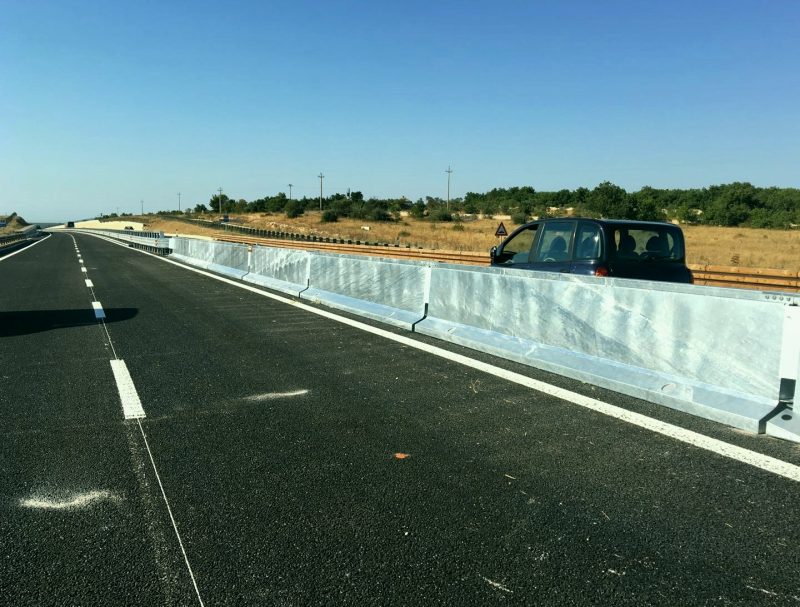
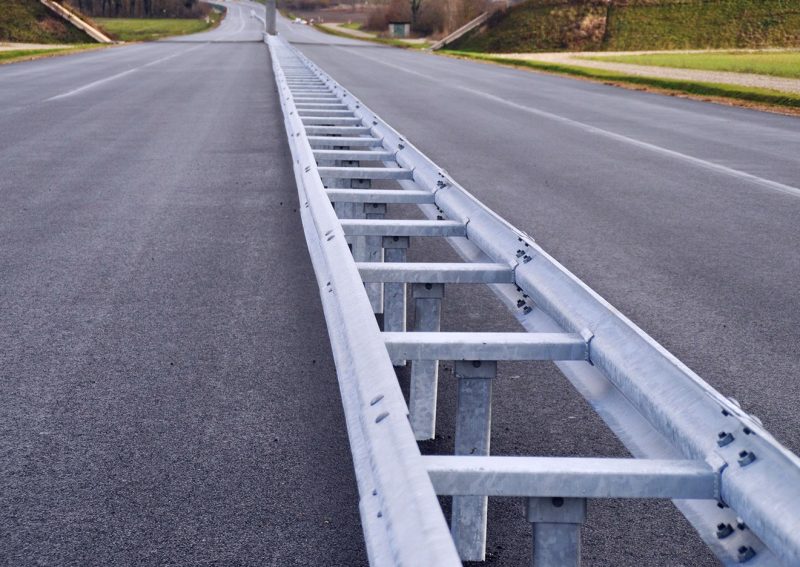
Wire rope is not the only barrier in the toolkit, and it is not always the right one. Concrete barriers — the solid or stepped profiles often seen on motorways — are rigid and almost maintenance-free, but they transfer far more force to the vehicle and are reserved for places where deflection space is tight or traffic volumes are very high. Steel W-section guardrail, the corrugated metal barrier familiar on bends and bridge approaches, sits in the middle: semi-rigid, deflecting a little, good for shorter runs and roadside hazards.
Wire rope wins on the open road for two reasons. It is the most forgiving on impact, and it is the cheapest to install per kilometre, which means a fixed safety budget protects a far longer stretch of road. The trade-off is maintenance: every serious hit damages the barrier and it has to be repaired before it can catch the next car. Choosing between the three is an engineering judgement about deflection space, speed, volume and cost — not a one-size answer.
Tension, Posts and the End Terminals
The performance of a wire rope system depends on details most drivers never notice. The cables are held under tension so they spring back into shape and keep working along the length of the run even after a hit at one point. The posts are designed to be weak by intention — they are meant to break, releasing the cables to do their job. And the end terminals, where the barrier begins and finishes, are engineered to absorb a head-on hit safely rather than spear the vehicle, which is why you will see them anchored and angled away from the traffic lane.
None of this is visible at 100km/h, and that invisibility is part of why the public conversation about these barriers so often misses how much engineering is packed into something that looks like a fence.
Where and Why They Get Installed
Targeting the Corridors That Carry the Risk
New Zealand does not, and could not, barrier every road. Installation is targeted at the corridors where the crash history and traffic volumes say the return in lives saved is highest — typically higher-speed rural state highways with a record of head-on and run-off crashes. This is the systemic logic of road safety investment: a limited budget chases the kilometres where it will prevent the most harm, which is why a busy inter-regional highway gets median wire rope while a quiet back road does not.
That targeting is also where regional equity enters the frame. The corridors that get protected first are usually the high-volume ones, which can leave lower-volume rural communities waiting longer for the same protection on roads that feel just as dangerous to the people who drive them every day.
Median Versus Roadside: Two Different Jobs
It is worth separating the two places barriers go, because they solve different problems. A median barrier sits between the opposing traffic streams and exists to stop cross-centreline head-ons. A roadside barrier sits on the outside edge and exists to stop run-off-road crashes into ditches, poles, trees and drops. Wire rope is used in both positions, but the design, the deflection space and the hazard being shielded are different.
On a wide rural highway you will often see both at once: a median run keeping the two directions apart, and roadside runs guarding the worst of the off-road hazards. Together they turn a corridor where a single mistake could be fatal into one where the same mistake is survivable — which is exactly the outcome the Safe System is built to produce.
The Debate New Zealand Keeps Having
The Motorcyclist Concern and What the Evidence Shows
No part of this topic generates more heat than the objection from motorcyclists, who have long argued that wire rope barriers — the so-called ‘cheese cutters’ — pose a particular danger to a rider thrown from a bike. The concern is sincere and deserves to be taken seriously rather than waved away: a rider sliding into exposed posts and cables is in a different situation from a car occupant wrapped in a steel cage.
The evidence, though, is more nuanced than the nickname suggests. International and New Zealand reviews have generally found that the barrier a motorcyclist hits is far less dangerous than the oncoming vehicle, tree or pole it prevented them from hitting — the relevant comparison is not barrier-versus-nothing but barrier-versus-whatever-is-behind-it. At the same time, the sector has responded to the concern with rub rails and post designs intended to reduce the snagging risk. Honest coverage holds both things at once: the worry is legitimate, and the weight of evidence still supports the barriers.
Cost, Mowing and the Everyday Gripes
Beyond the safety debate sits a quieter set of grumbles. Wire rope makes roadside mowing and maintenance harder and more expensive. A barrier that has done its job in a crash is a barrier lying damaged until a crew can repair it, and on a busy corridor those repairs are frequent. Some drivers simply dislike the visual clutter of posts and cables down the middle of a once-open road.
These are real costs, and a publication that respects its readers should name them rather than pretend the barriers are free. The case for them does not rest on their being cost-free; it rests on the lives-saved-per-dollar comparison coming out overwhelmingly in their favour. That is a defensible trade-off, but it is a trade-off, and the maintenance bill is part of the honest accounting.
What the Numbers Say, and What Comes Next
The Crash-Reduction Record
The reason median and roadside barriers keep getting installed despite the gripes is that the results are hard to argue with. Flexible safety barriers are among the most effective interventions available, with international and local evaluations crediting them with very large reductions in deaths and serious injuries on the corridors where they are installed — the kind of step-change that speed-limit tweaks and education campaigns rarely match on their own.
That effectiveness is why barriers feature so heavily in the infrastructure side of road-safety investment. When the goal is measured in lives rather than journey times, a length of wire rope is one of the best-value tools an engineer has.
Where New Zealand Goes From Here
The future of median protection in New Zealand is mostly a question of pace and money. The corridors most in need are well understood; what governs how fast they get treated is the size of the maintenance and capital budgets and the political appetite to keep investing in something whose success is invisible by definition — a crash that does not happen makes no headline.
That is the quiet bind of preventive safety. A wire rope barrier asks the public to pay now for fatalities that will never be counted because they never occur. Making that bargain visible — explaining what the cables actually do and why the median is no longer just a painted line — is part of the job, and it is a job worth doing every time the debate flares up again.
A wire rope barrier looks like a fence and works like a catcher’s mitt, turning crashes that would have been fatal into ones people survive. The gripes about cost, mowing and rider safety are real and worth naming honestly. But on the corridors where they go in, the evidence keeps landing in the same place: the median was never just a line, and treating it as a wall saves lives.
4 Comments
Nicely put on the catch-deflect-absorb physics. The thing the public miss is deflection space — you can’t just bolt wire rope anywhere, you need room behind it for the cables to do their job, which is exactly why concrete goes in where the median is tight.
As a rider I’ll never love them, but I’ve read the same reviews you cite and the honest answer is the barrier beats the oncoming logging truck every time. The rub rails on the newer installs help. Credit for not waving the concern away.
The maintenance cost is real — try mowing a median full of posts. But a few thousand on mowing against one fatal avoided isn’t a hard sum. People just don’t see the crash that didn’t happen.
Good point about the high-volume corridors getting done first. Our stretch of state highway has the same crash history but half the traffic, so we keep waiting while the busy roads get the cables. Regional equity in action.