Tolling in New Zealand: Policy, Practice, and Politics
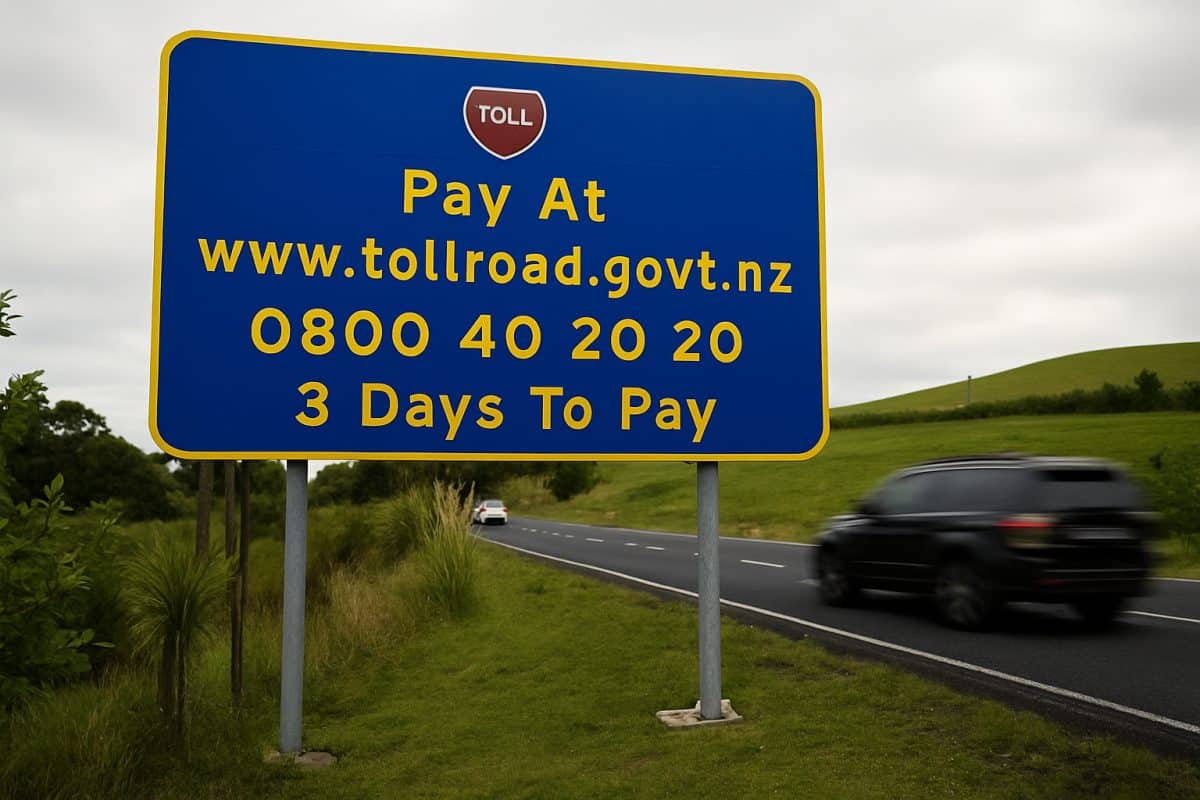
New Zealand has two toll roads. The country with the longest stretch of state highway per capita, a $40 billion decade-long transport programme, and a chronic infrastructure deficit has managed to toll exactly two stretches of new expressway in twenty years of having the legislative tools to do it. That number is not an accident or an oversight — it is the product of legislation written to make tolling legally possible while keeping it politically rare.
The Legislative Architecture Behind NZ Tolling
How the Land Transport Management Act Created the Framework
The legal authority to toll a road in New Zealand sits in a relatively slim corner of the Land Transport Management Act 2003. Part 2A — inserted by the Land Transport Management Amendment Act 2008 — is where the tolling powers actually live, and it is worth being precise about what it says, because public debate about road pricing in NZ routinely conflates what the law permits with what politicians have chosen to do with that permission.
The framework works through an Order in Council mechanism. If a road meets the statutory criteria, the Minister of Transport may recommend to Cabinet that a Toll Road Order be made. The Order designates the road, sets the maximum toll amount, and establishes the toll authority responsible for collection and administration. Waka Kotahi (the NZ Transport Agency) is the toll authority for both existing toll roads and would be for any future ones.
The 2008 amendments were the critical refinement. Before them, tolling legislation was less precisely constrained — the criteria were broader and more subject to ministerial discretion. The amendments introduced the three specific tests that now define NZ’s tolling framework, partly in response to early-stage discussions about tolling existing roads that never progressed but created political anxiety. Parliament was essentially drawing a line around what it considered acceptable use of the tolling power.
The Three Tests Every Proposed Toll Road Must Pass
The three statutory criteria are straightforward to state but have significant limiting consequences in practice.
First, the road must be new infrastructure or a new lane on an existing road. A toll cannot be applied to an existing road that has been carrying free traffic. This single constraint eliminates the most common international approach — retrofitting tolls onto existing motorways to generate revenue from infrastructure already paid for by taxpayers. In NZ, if you want to toll something, you have to build it first.
Second, a free alternative route must remain available to users who cannot or will not pay the toll. The alternative does not need to be as fast or as convenient — it simply needs to exist and remain accessible. For the Northern Gateway, that alternative is the old SH1 through Orewa. For the Tauranga Eastern Link, it is the existing SH2 route. Removing a free alternative to apply a toll would require amending the Act — it is not something any transport agency can do administratively.
Third, toll revenue must be applied to the tolled facility itself or closely related transport infrastructure. Revenue hypothecation is mandatory. The money collected on the Northern Gateway must go back into the Northern Gateway corridor — it cannot be pooled into general NLTF funding for use elsewhere in the network. This constraint is examined in the next section, but its significance here is structural: it limits tolling as a broad transport financing mechanism. You can use it to fund specific new infrastructure; you cannot use it to top up the national road maintenance budget.
Revenue Hypothecation: Where the Money Goes
Toll revenue hypothecation is the least-discussed but arguably most consequential feature of NZ’s tolling framework, because it fundamentally shapes what tolling can and cannot achieve as a policy tool.
Under the LTMA framework, tolls collected on a designated toll road must be applied to the capital and operating costs of that road, or to closely related infrastructure improvements in the same corridor. Waka Kotahi publishes annual toll road financial statements that show revenue, operating costs, and the balance applied to debt repayment. For the Northern Gateway, recent years have seen annual toll revenue in the range of $20-25 million, with the bulk servicing the original construction financing.
The consequence of hypothecation is significant: once the facility debt is retired, there is a policy question about what happens to the revenue stream. The legislation contemplates that tolling can cease once debt is retired — there is no requirement to keep collecting indefinitely. In practice, the expectation for both existing toll roads is that tolling will eventually end, returning the facility to the free public network. This is a fundamentally different model from, say, a French autoroute concession where tolling continues as a revenue mechanism long after construction costs are recovered.
For anyone arguing that NZ should expand tolling as a transport funding mechanism — to replace declining fuel excise revenue as EVs grow, for instance — hypothecation is the structural obstacle. You cannot use a new toll road’s revenue to fix roads elsewhere. Each toll road is its own financial island. That is a deliberate policy choice, not an oversight, and changing it would require legislative amendment.
The Two Roads That Actually Made It Through
Northern Gateway: Auckland’s First Tollway and Its Traffic Realities
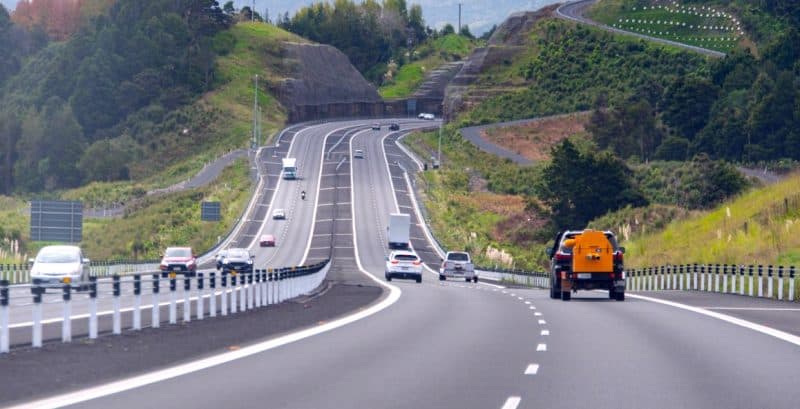
The Northern Gateway Toll Road opened in February 2009, making it NZ’s first operational toll road under the LTMA framework. It runs 7.5 kilometres along State Highway 1 north of Auckland, from Orewa to Puhoi, including the Johnstown Tunnel — a 240-metre bore through the Weiti headland that eliminated the most congested section of the old coastal route.
There are no toll booths. The entire system operates on automatic number plate recognition (ANPR) — cameras record each vehicle passing the gantries, and the toll is either charged to a registered account or invoiced by post at a higher rate. The pricing structure distinguishes between pre-paid account holders, who pay less, and occasional users who pay the full rate plus processing charges. As of 2024, the standard toll is $2.60 for a light vehicle with an account, rising to around $5.00 for invoiced transactions. Heavy vehicles pay more. Current pricing and account details are managed through Waka Kotahi’s toll road portal.
What is genuinely interesting about the Northern Gateway is the behaviour split between toll road users and free-alternative users. A substantial proportion of traffic heading north still uses the old SH1 through Orewa, particularly for short local trips where the time saving is minimal. The toll road captures most of the through traffic — commuters and freight heading to Warkworth and beyond — while the free route continues to serve local movement. This is exactly the user segmentation the framers of the legislation intended: those for whom the time value exceeds the toll pay it; those for whom it does not, have a genuine alternative.
Tauranga Eastern Link: Bay of Plenty’s Toll Road and the Bridge Question
The Tauranga Eastern Link opened in stages between 2012 and 2015, completing a 23-kilometre connection from Paengaroa (just east of Te Puke) to Tauranga via the Te Maunga interchange on the city’s eastern fringe. It is a four-lane expressway that cut travel times between Tauranga and the eastern Bay of Plenty considerably, reducing the distance and eliminating a series of at-grade intersections on the old SH2 alignment.
The persistent public confusion around the Tauranga toll road involves the Tauranga Harbour Bridge. The bridge carries SH2 into the Tauranga CBD and is not tolled — it is a state highway structure maintained by Waka Kotahi under the standard network management model. Early planning documents for the Eastern Link corridor did include assessments of bridge tolling as one funding option, and some media coverage at the time conflated the two. The bridge remains free. The toll is collected on the new expressway section, not on the existing bridge, and not on the Te Maunga link roads.
Toll pricing mirrors the Northern Gateway structure: account holders pay a lower rate, invoiced users pay more, heavy vehicles pay by axle weight. The Tauranga freight community — kiwifruit and avocado logistics in particular, given the proximity to the Port of Tauranga — uses the expressway extensively. The travel time savings on loaded trucks are substantial enough that the toll is routinely treated as an operating cost rather than a discretionary spend. That economic logic — freight users for whom time has a dollar value — is part of why the Eastern Link has performed reasonably well operationally.
What Both Routes Have in Common — and What That Tells You
Strip away the geography and you are looking at an identical template. Both toll roads are new-build expressways on corridors where the old route was genuinely inadequate and a free alternative remained in place. Both serve high-growth urban areas — Auckland’s northern fringe and Tauranga’s eastern expansion — where population growth justified significant new infrastructure. Neither was retrofitted onto existing free roads. Neither removed a free route. Both used the ANPR collection model rather than physical toll plazas.
This is not coincidence. It is the only template that survives the statutory criteria and the political environment simultaneously. The legislation was drafted to make this template work and make every other template legally unavailable. That is a feature, not a constraint — it reflects Parliament’s judgment about the conditions under which tolling is acceptable in NZ’s political culture.
It also means that proposals to toll existing Auckland motorways, the Wellington urban motorway system, or the Christchurch expressways have no legislative pathway under current law. You would need to amend the Act before any of that becomes possible. And the moment you propose amending the Act to permit tolling of existing free roads, you are fighting a different and considerably harder political battle — not the relatively manageable one of proposing a toll on a new road most people currently do not use.
Why NZ Never Built the Sydney Motorway Network
The Australian Model: Private Capital, Long Concessions, Dense Networks
Sydney’s tollway network is one of the most extensive private motorway systems in the world — and one of the most complained-about. Drivers crossing the city on a regular commute can accumulate toll charges of $30-50 per day across multiple operators. The network grew through a series of long-term concessions — typically 45 to 99 years — granted to private consortia who borrowed against projected toll revenue to finance construction.
The model is elegant in principle: the government specifies a road it wants built, private capital funds the construction, and the concessionaire recoups the investment over the concession period through tolls, after which the asset reverts to public ownership. Melbourne’s CityLink and EastLink, Brisbane’s Gateway Motorway system, and Perth’s Mitchell Freeway extensions followed variations of this structure. The financial architecture requires traffic density: the higher the daily vehicle throughput, the faster the debt is serviced and the lower the toll rate needed to achieve financial viability.
The consumer experience in Sydney has become a cautionary tale. Multiple operators with different billing systems, competing loyalty schemes, a patchwork of tolling zones, and some of the highest urban toll charges in the world have generated sustained public anger. The NSW government has progressively intervened with toll relief schemes — effectively subsidising the private operators’ revenue model from public funds. It is worth holding that experience in mind when assessing the appeal of the Australian model for NZ.
NZ’s Scale Problem: Not Enough Traffic to Service the Debt
The private concession model has an unforgiving economic floor: you need enough traffic to service the construction debt at a politically tolerable toll rate. Sydney, Melbourne, and Brisbane have it. Most of NZ does not.
Auckland is the marginal case — and even there, the arithmetic is difficult. The Waterview Connection, which opened in 2017 as New Zealand’s longest road tunnel, was assessed during the planning phase for private financing options. The traffic modelling showed that private financing would require toll rates higher than the political environment would support, particularly given the availability of adjacent free motorway capacity. The decision to fund it through the NLTF rather than a toll concession was partly ideological, but the economics supported it: at the traffic volumes projected, a private concession model would have required tolls that priced out a significant proportion of current users.
For any NZ city below Auckland, the case is even weaker. Wellington’s urban motorway serves a commuter market of around 400,000 people. Christchurch is smaller still. The concession periods required to service construction debt on a Wellington expressway at politically viable toll rates stretch into territories that make private investors nervous — the further out you forecast revenue, the riskier the investment. A 99-year concession that assumes NZ’s transport patterns in 2124 will resemble today’s is not a conservative financial assumption.
The NLTF as Alternative: Why NZ Solved the Same Problem Differently
The National Land Transport Fund is, in a real sense, the NZ alternative to the private tollway model. It is a ring-fenced, hypothecated fund fed by fuel excise duty, road user charges from diesel vehicles, and motor vehicle registration fees. All road users contribute in proportion to their use — at least in principle, and the transition to EVs is disrupting this — and the proceeds are allocated across new construction, state highway maintenance, local road subsidies, and public transport funding.
The NLTF solves the same problem Australia’s toll roads solve — directing road user payments to road infrastructure — but through a collective mechanism rather than a facility-by-facility approach. The advantages are real: no toll avoidance by lower-income users, no infrastructure treated as a private cash stream, no concession terms that lock governments into 50-year commercial arrangements. Every road in the network benefits from the fund, not just the ones with sufficient traffic to attract private finance.
The tradeoff is capital velocity. A private tollway concession can mobilise billions of dollars of construction financing quickly by leveraging future revenue streams. The NLTF can only spend what it collects, and it must allocate across a network of competing priorities. Infrastructure that would benefit from rapid construction — to capture economic growth or relieve acute congestion — gets queued behind maintenance programmes and existing commitments. The Australian model builds roads faster when it works. NZ’s model builds them more equitably, but more slowly. That is a genuine policy tradeoff, not a clear right answer.
The Political Ceiling and What Would Have to Give
The Free Alternative Requirement as Political Shield
The requirement to maintain a free alternative is often presented as a consumer protection measure. That is accurate but incomplete. It is also the mechanism that has made NZ’s two toll roads politically survivable — and it functions as a political shield for the minister and Cabinet as much as a safeguard for drivers.
When the Northern Gateway was proposed, the most potent objection was that state highway users who could not afford the toll would be forced onto slower, less safe secondary routes. The retention of the old SH1 through Orewa neutered that argument: the toll road offered a faster option, not the only option. No one was compelled to pay. The political framing became “a choice between time and money” rather than “a tax on using the road.” That is a vastly different conversation, and it is the one the government wanted to be having.
Any proposal to retrofit tolls onto existing motorways — to toll the Auckland Harbour Bridge, say, or the Northern Motorway south of Greville Road — would immediately reopen the harder conversation. There is no free alternative to the Harbour Bridge for cross-harbour traffic. The moment you remove the alternative, you convert the toll from a user choice into a compulsory charge, and the political arithmetic shifts substantially. Opponents can credibly argue that low-income workers on the North Shore are being taxed for their geography. That argument is considerably harder to rebut than objections to paying for a new road you could avoid if you chose.
Road Pricing Reform: The Distance from Policy Debate to Law
If you follow NZ transport policy discussions over the past decade, you will encounter a recurring pattern: serious analytical work recommending expanded road pricing, followed by a period of political consideration, followed by effective shelving. The Productivity Commission, the Infrastructure Commission, multiple Ministry of Transport strategy documents, and various Transport Minister briefing papers have all pointed in the same direction — NZ needs to move beyond fuel excise as its primary road funding mechanism and toward more sophisticated road pricing that can manage congestion as well as fund infrastructure.
The analytical case is not seriously contested. Fuel excise is a declining revenue base as EVs enter the fleet. A distance-based charge that replaces fuel excise — essentially a universal RUC — would be more equitable and more durable. Add time-of-day pricing on congested urban corridors and you have a genuine tool for managing peak demand rather than just taxing it bluntly.
The political case has not been made successfully by anyone yet. Road pricing reform faces a coalition of opposition that does not need to coordinate to be effective. Suburban homeowners dependent on car commuting see higher costs and few visible benefits. Freight operators are embedded in current RUC structures and wary of anything that disrupts known costs. Rural communities correctly observe that they have no alternative transport modes and would pay more without benefiting from congestion relief. And the transaction cost of explaining GPS-based road pricing to a general electorate that currently pays petrol tax without thinking about it is not trivial. Every government since the 2008 amendments has found other uses for its political capital.
What a Third Toll Road Would Actually Require
A third NZ toll road is more plausible than the current silence on the topic suggests, but less imminent than transport advocates sometimes imply. The conditions that would make it happen are specific.
The corridor would need to be new infrastructure — somewhere currently under active construction consideration. It would need a free alternative, which means it must be a bypass or new route, not a capacity upgrade to an existing free road. It would need high enough traffic volumes to make the ANPR system and Waka Kotahi administration cost-effective. And it would need a government willing to spend some political capital on the framing — not a lot, if the free-alternative protection is maintained, but some.
The most plausible candidates are both in Auckland. A tolled Northwestern Motorway extension toward Kumeu, or a second Waitemata Harbour Crossing built as a tunnel while the existing bridge remains free, could satisfy all four conditions. The Harbour Crossing is particularly interesting: the construction cost of a second crossing would be substantial enough that toll financing would be worth serious assessment, and the traffic volumes on that corridor are among the highest in NZ.
The real signal to watch is fiscal. When the NLTF cannot fund a priority project on its usual timeline and the corridor has the traffic to support a toll, political resistance weakens considerably. NZ has had two toll roads for fifteen years because two projects met all the conditions at the same time. The next one will happen when those conditions align again — which is a matter of when, not if.
The legislation has not changed substantially since 2008 because it does not need to — it works as designed, as a narrow permission rather than a general licence. Whether NZ needs to widen that permission is a question the transport sector keeps raising and Parliament keeps deferring. The deferral will eventually end, almost certainly when a project arrives that the NLTF cannot fund quickly enough and the traffic volumes make the arithmetic work. That is not a political argument for tolling; it is just what happens when fiscal constraints and infrastructure demand occupy the same corridor at the same time.
4 Comments
The point about the free alternative being a political shield rather than just a consumer protection — that reframing is genuinely useful. I’ve been in council meetings where people treat the free-route requirement as a quirk of the legislation, but you’re right that it’s doing a lot of political work. The Northern Gateway would have been a much harder sell without Orewa staying open.
The hypothecation constraint is something I hadn’t thought through fully. So once the Northern Gateway debt is retired, what actually happens — does tolling just… stop? Is there any precedent for how NZTA handles that transition?
Good piece. Worth noting the Sydney comparison cuts both ways though — the NSW government is now spending hundreds of millions per year on toll relief subsidies because the original concession terms locked in rates that became politically untenable. The private finance model “worked” in the sense that the roads got built, but the long-term fiscal exposure is significant. NZ dodged that by staying with the NLTF, whether intentionally or not.
The Waterview section is interesting. I always assumed it wasn’t tolled for political reasons, but the traffic volume argument makes sense too. At those volumes you’d have needed toll rates that would have pushed a lot of western Auckland commuters onto local roads. The NLTF solution was slower to deliver but probably the right call.